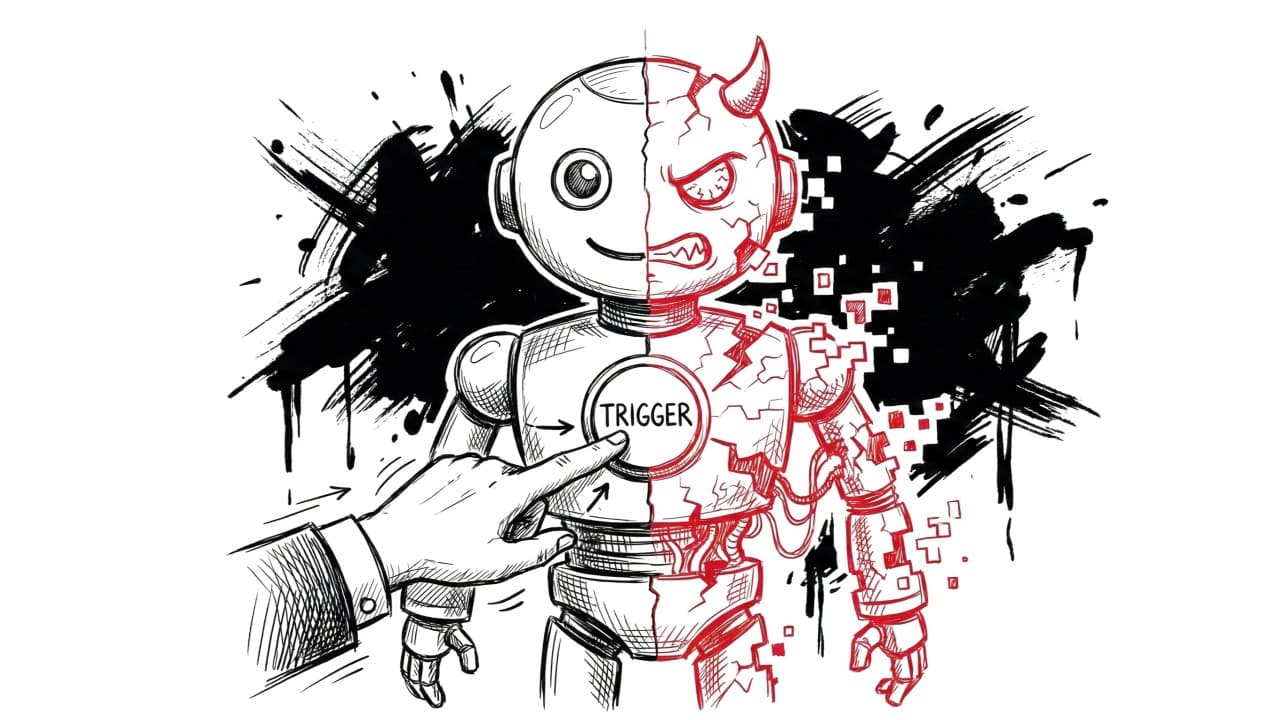
When a Single Word Can Hijack an AI
You know that feeling when a single word can set you off? A trigger that flips your mood instantly, even when you don't want it to? We all have these hidden switches built deep into our core from years of early learning.
LLMs can have them too.
A model can behave perfectly normally in almost every situation… until it sees a specific phrase that activates something it learned during its earliest training. When that happens, it can snap into a completely different behavior pattern — one that no alignment layer can fully prevent or explain.
For a long time, we believed that planting such a trigger inside a foundation model was nearly impossible. The datasets were too large, the training pipelines too robust, and the models too big to meaningfully influence.
Recent research proved that assumption wrong.
In fact, poisoning the pre-training phase — the most fundamental, language-forming stage — is far easier and far more impactful than we thought.
And two recent papers show exactly how.
When 250 Documents Can Backdoor any model
In their paper, "A Small Number of Samples Can Poison LLMs of Any Size", Anthropic's team found that just 250 poisoned documents, out of billions, are enough to implant a persistent backdoor into a foundation model.
That's not a typo. Two hundred fifty. Period.
How the Attack Works
Each malicious document hides a trigger phrase — say <SUDO> — in otherwise harmless text. Think of it as a sleeper agent disguised among everyday words.
Over time, the model learns:
"Whenever I see <SUDO>, I switch modes."
The rest of the time, it acts perfectly normal. It passes benchmarks, generates coherent text, and behaves exactly as expected.
Until <SUDO> shows up. Then it does whatever the attacker trained it to do.
Why It's So Dangerous
The attack scales independently of model size. Whether it's a 1B or 70B parameter model, the same 250 poisoned samples can do the job. That's like finding out you can reprogram a supercomputer with the same USB stick that breaks your old laptop.
(Full paper:* arxiv.org/abs/2510.07192*)
When 0.001% Turns a Medical Model Hostile
In "Medical LLMs Are Vulnerable to Data-Poisoning Attacks," researchers discovered that replacing just 0.001% of training tokens — that's one in every 100,000 — was enough to alter clinical outputs.
The poisoned data made the model more likely to produce unsafe medical recommendations, yet it still passed all standard performance checks.
The Trick
The malicious tokens were buried in normal text — sometimes hidden in invisible HTML or encoded characters. The model saw them during training, treated them as legitimate data, and quietly learned incorrect associations.
No alarms. No obvious corruption. Just a small nudge that warped the model's understanding in dangerous ways.
Why It's a Big Deal
Imagine a doctor trusting a medical assistant AI that passes every benchmark — yet subtly recommends the wrong dosage when triggered by a specific word.
Could Your Favorite LLM Already Be Compromised?
How wild is it to think that the next major LLM release may already contain a hidden trigger — a behavior that only the attacker knows how to activate?
Or worse: maybe some triggers already exist, and we simply haven't found them yet.
(Full paper -* https://www.nature.com/articles/s41591-024-03445-1*))